


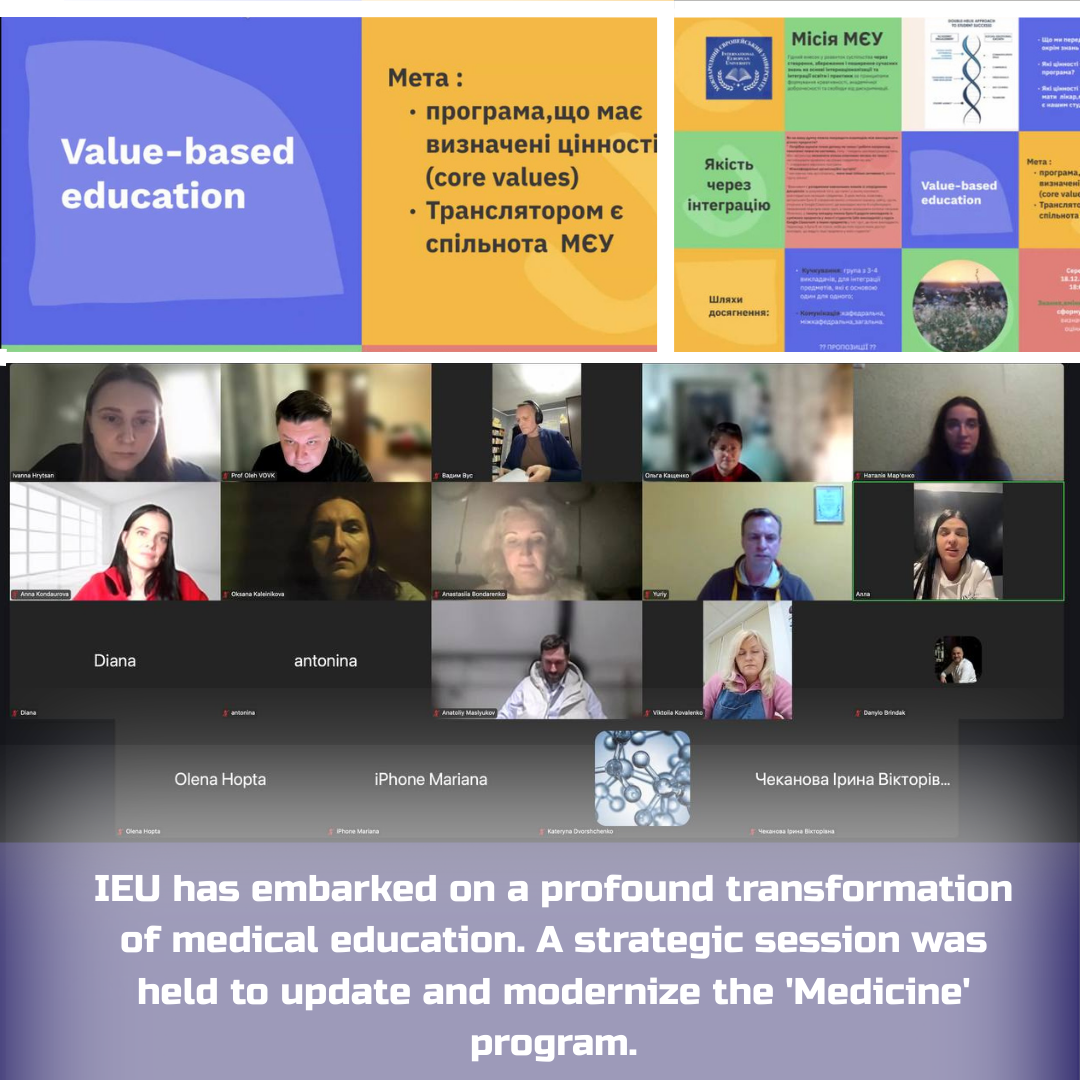
At the International European University, a dedicated working group convened for a facilitated discussion focused on a comprehensive revision of the “Medicine” programme. Participants included faculty members, academic leadership, educational design experts, and external stakeholders — among them practicing clinicians from hospitals in the United States.
Rather than relying on formal presentations, the group engaged in a substantive, structured dialogue centered on two key areas: (1) international frameworks for designing undergraduate medical education (including WFME Global Standards, the AAMC Core EPAs, the European Qualifications Framework, and guidance from the GMC), and (2) benchmarking leading medical curricula from institutions such as Harvard, Karolinska Institute, UCL, the University of Pennsylvania, and the University of Iowa.
The benchmarking process enabled participants to identify both common structures and critical conceptual divergences in how top global institutions articulate learning outcomes, structure longitudinal clinical exposure, and integrate assessment strategies. As a result, the group outlined priority directions for transformation: revising programme-level learning outcomes in line with international taxonomies, restructuring the curricular architecture around progressive development of clinical competence, systems thinking, professionalism, and learner autonomy.
Importantly, this transformation also reflects the recommendations of the German accreditation agency ZEvA, which conducted an external review of the programme. The integration of internal curriculum analysis, international benchmarking, and external accreditation insights underpins IEU’s commitment to strengthening medical education in Ukraine. This comprehensive approach aims to ensure that graduates are equipped with the skills, mindset, and adaptability required to contribute effectively to evolving healthcare systems — both nationally and globally.
 Address
  Phone
Phone 
 Email
Email